
Rust Converter vs. Rust Inhibitor vs. Rust Coating: What’s the Difference?
Walk into any hardware store’s corrosion aisle and you’ll find three categories of product sitting next to each other, often with labels that don’t do much to explain what actually separates them: rust converters, rust inhibitors, and rust coatings. People grab whichever one is cheapest or closest to eye level, and more often than not, it’s the wrong choice for the job, either because it doesn’t address the metal’s actual condition or because it’s solving a problem the metal doesn’t have. Understanding rust converter vs. rust inhibitor vs. rust coating isn’t complicated once you know what each one is actually designed to do, and getting it right the first time saves a redo down the line.
This guide breaks down what each product category actually does, how they work differently at a chemical level, and which one fits which situation.
The Core Difference: What Condition Is the Metal In?
Before getting into the specifics, there’s one question that decides most of this choice on its own: is the metal already rusted, or are you trying to prevent rust from starting in the first place? Rust converters exist specifically for metal that already has active rust on it. Rust inhibitors and rust coatings are generally aimed at metal that’s either bare and clean or already protected, working to keep rust from forming or spreading rather than reacting with existing corrosion.
Getting this distinction right first narrows the choice considerably before you even get into product-specific details.
Rust Converters: Chemistry That Reacts With Existing Rust
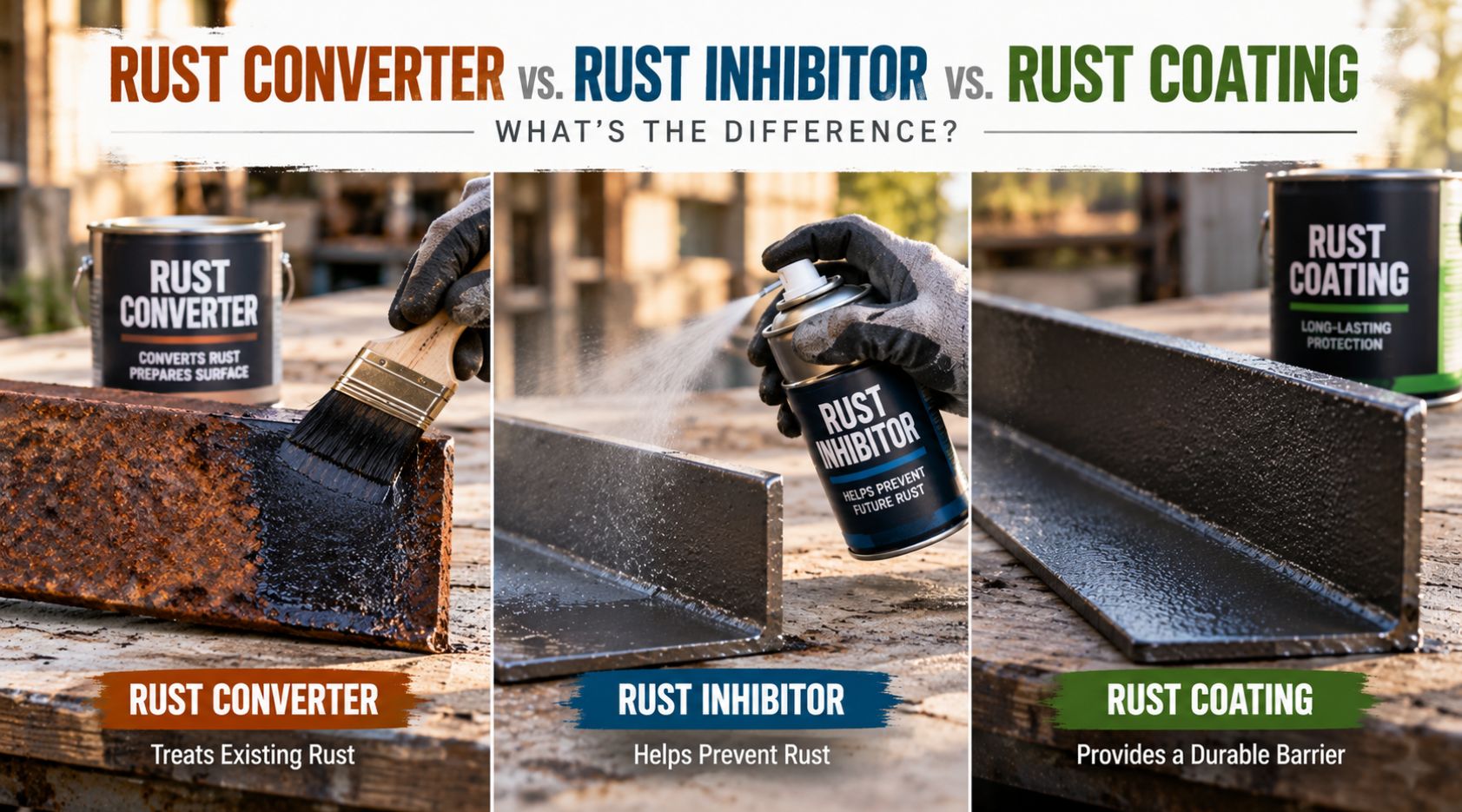
A rust converter is a chemical treatment applied directly onto existing rust, and it works through an actual chemical reaction rather than just sitting on top of the corroded surface. Most rust converters use tannic acid or a similar compound that reacts with iron oxide, the rust itself, converting it into a more stable, inert compound, often iron tannate, which is dark and chemically stable rather than continuing to flake and spread the way active rust does.
This is the key thing that separates a rust converter from the other two categories: it doesn’t just cover rust, it chemically transforms it into something that’s no longer actively corroding. That’s genuinely useful on metal with light to moderate surface rust where full mechanical removal, grinding or sandblasting back to bare metal, isn’t practical or necessary. It’s less useful, and generally not recommended, on heavy, flaking rust or on structural applications where the underlying metal’s integrity is already compromised, since a rust converter treats surface chemistry, not structural loss.
Most rust converters also leave a surface, once dried, that’s paintable, and many double as a primer, though checking the specific product’s instructions for topcoat compatibility and timing matters, since not every converter is designed to be painted over immediately.
Rust Inhibitors: Preventing the Reaction From Starting
A rust inhibitor takes a fundamentally different approach. Rather than reacting with existing rust, it works to prevent the electrochemical reaction that causes rust in the first place, either by displacing moisture and creating a barrier that keeps water and oxygen away from the metal surface, or through vapor-phase inhibitors that release a protective molecular film in an enclosed space, common in packaging and storage applications for tools and machined parts.
Oil-based rust inhibitors are common for tools, machinery, and equipment that needs protection during storage or between uses, since they’re easy to apply, don’t require extensive prep, and can often be wiped or cleaned off later if needed. The tradeoff is that many oil-based inhibitors aren’t particularly durable against abrasion or heavy handling, and they’re generally not intended as a long-term, permanent finish the way a coating is.
Rust inhibitors are the right tool when the goal is temporary or ongoing protection on clean or lightly used metal, not when there’s already active corrosion that needs to be addressed first.
Rust Coatings: A Durable, Long-Term Barrier
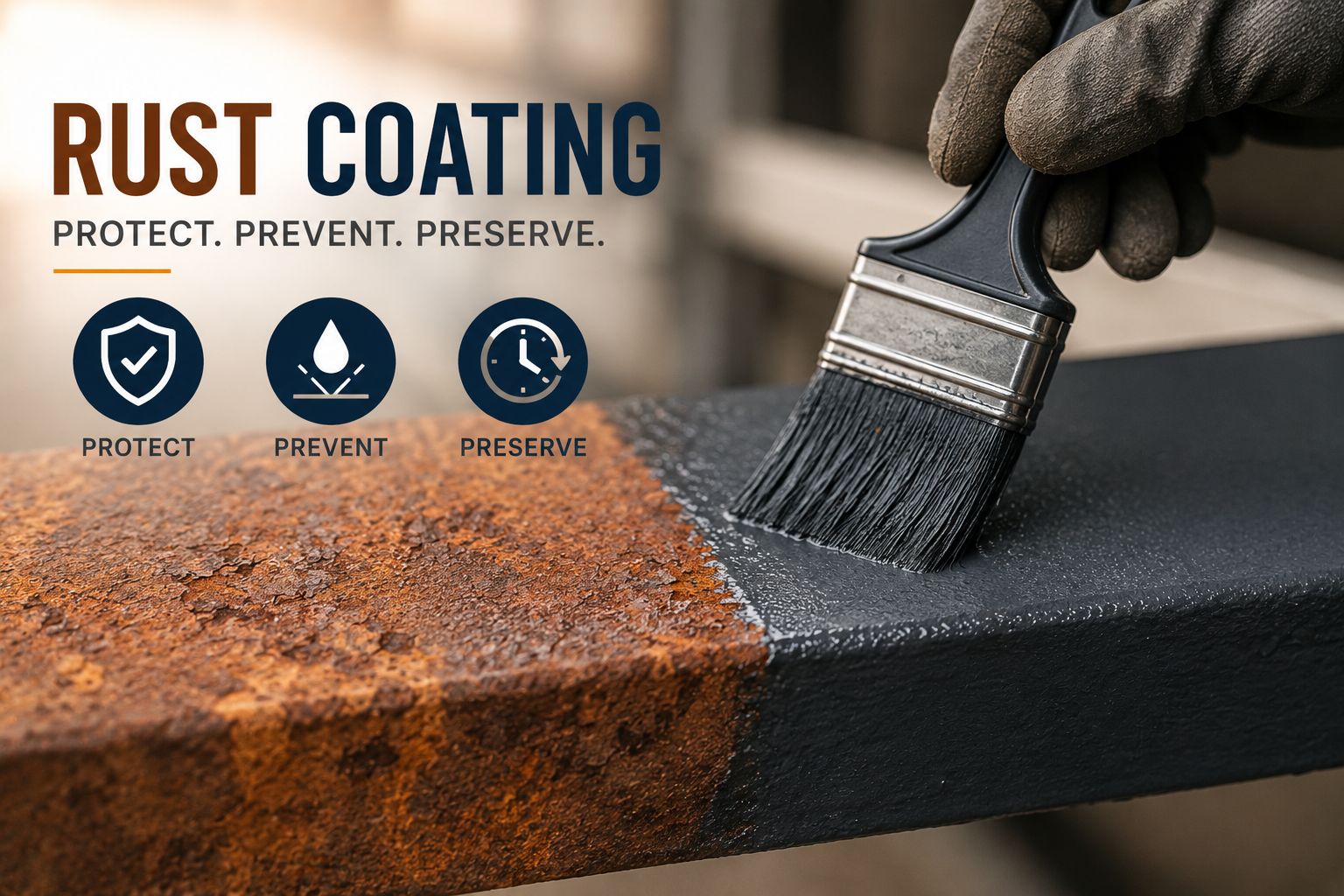
Rust coatings are film-forming products, paints, epoxies, polyurethanes, and similar chemistries, designed to create a durable, long-lasting barrier between metal and the environment. Unlike a rust inhibitor’s often thin, sometimes temporary protective film, a proper rust coating cures into a hard, continuous layer meant to stay in place for years under real-world wear, weather, and handling.
This is generally the right choice for metal that’s either bare and properly prepped, or that’s already been treated with a rust converter and is ready for a permanent topcoat. Rust coatings vary significantly in performance depending on the specific chemistry, some are more flexible and impact-resistant, others prioritize chemical resistance or UV stability, so matching the coating type to the actual exposure conditions, outdoor weathering, chemical contact, abrasion, matters more than assuming any rust coating will perform identically to another.
Can These Be Used Together?
Yes, and in a lot of real projects, they are. A common sequence for metal with existing surface rust looks like this: treat active rust with a rust converter to stabilize it chemically, then apply a rust coating over the converted surface for long-term, durable protection. Rust inhibitors typically operate on a separate track, more suited to temporary protection during storage or transport than as a permanent part of a finished project, though some products blend inhibitor properties into a coating formulation.
Understanding that these three categories solve different problems, rather than being three competing options for the exact same job, is really the core insight that makes the rust converter vs. rust inhibitor vs. rust coating question easier to answer for any specific project.
Choosing the Right Product for Your Situation
If the metal has existing rust you want to stabilize without full mechanical removal, a rust converter is the starting point, often followed by a rust coating once the converted surface has dried.
If the metal is clean, bare, or already coated, and you need ongoing or temporary protection, a rust inhibitor fits, particularly for tools, machinery, or equipment in storage or between regular use.
If you need a permanent, durable, long-term protective finish on prepped metal, a rust coating is the right category, chosen based on the specific exposure conditions the finished surface will face.
Rust Converter vs. Rust Inhibitor vs. Rust Coating Comparison
| Factor | Rust Converter | Rust Inhibitor | Rust Coating |
|---|---|---|---|
| Best used on | Metal with existing surface rust | Clean or lightly used metal | Bare, prepped, or converted metal |
| How it works | Chemically reacts with rust, converting it | Displaces moisture, blocks oxygen contact | Forms a durable physical barrier |
| Durability | Not a standalone finish, usually needs a topcoat | Often temporary, wipes or wears off | Long-lasting, designed for permanence |
| Typical use case | Pre-treatment before painting or coating | Tool and equipment storage protection | Final protective finish on structures, equipment |
| Can be combined with the others | Yes, commonly paired with a coating afterward | Generally used on its own or before a coating | Often the final step after conversion or prep |
Common Mistakes People Make With This Choice
Applying a rust coating directly over heavy, active rust without addressing it first is one of the most common and most avoidable mistakes, since coating over unstable, flaking rust just traps the problem underneath a surface that looks fine temporarily and fails early. Using a rust inhibitor as a substitute for a real long-term coating on something that needs permanent protection is another frequent misstep, since inhibitors generally aren’t built for the durability a structural or high-wear application actually needs. And skipping surface preparation entirely, assuming any of these three products can compensate for a dirty, oily, or improperly cleaned surface, undermines the performance of all three categories regardless of which one is chosen.
Things to Consider Before Choosing
- What condition is the metal actually in right now, clean, lightly rusted, or heavily corroded?
- Is this project looking for temporary protection during storage, or a permanent finish meant to last for years?
- If there’s existing rust, has it been assessed for whether a converter is appropriate, or whether mechanical removal is actually needed first given the severity?
- What exposure conditions will the finished surface face, indoor storage, outdoor weathering, chemical contact, heavy abrasion?
- Is the surface being properly cleaned and prepared before any of these products are applied, regardless of which category is chosen?
Frequently Asked Questions
Can I use a rust converter and a rust coating on the same project?
Yes, and this is a common and effective sequence, treating existing rust with a converter first, then applying a durable rust coating over the stabilized surface once it’s dry.
Is a rust inhibitor the same as a rust coating?
No. Rust inhibitors are generally thinner, often temporary protective films suited to storage and short-term protection, while rust coatings are durable, film-forming products meant for long-term, permanent protection.
Do I need to remove all rust before using a rust converter?
Generally no, that’s the point of the product, though very heavy, flaking, or structurally significant rust may need mechanical removal first regardless, since a converter addresses surface chemistry, not structural metal loss.
Which option is best for outdoor equipment exposed to weather year-round?
A properly matched rust coating is generally the right choice for permanent outdoor protection, since inhibitors typically aren’t durable enough for sustained weather exposure and converters alone don’t provide a long-term topcoat barrier.
Can rust inhibitors be used on metal that already has surface rust?
They’re generally intended for clean or lightly used metal rather than actively rusting surfaces, so addressing existing rust with a converter or mechanical removal first tends to produce better results than applying an inhibitor over active corrosion.
Conclusion
Rust converter vs. rust inhibitor vs. rust coating isn’t really a competition between three similar products, it’s three different tools built for three different situations: converting existing rust chemically, preventing rust from starting in the first place, and providing a durable, permanent barrier once the metal is properly prepped. Matching the right product to the metal’s actual condition and the project’s real durability needs, rather than grabbing whichever one is most familiar or most convenient, is what separates a rust treatment that actually holds up from one that needs to be redone within a season.